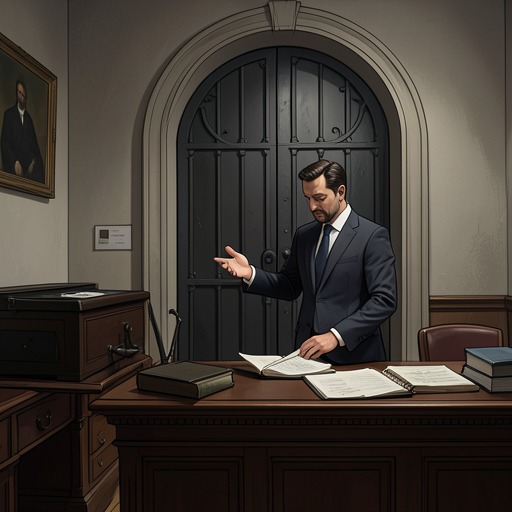
Two Police Officers Committed to a Mental Hospital
The RoomTwo Police Officers Committed to a Mental Hospital is the imagined judicial outcome of the Unnamed protagonist’s campaign against Harry and Fred. He pictures their alleged abuse of Mrs. Haagstromm being exposed in court, but the victory he constructs is not a criminal conviction: he imagines the officers judged unfit to serve and committed to a mental institution. The episode gives institutional form to his anger while revealing how thoroughly he has merged a call for accountability with a desire to punish.
Causes and Background
The imagined proceeding grows out of the Unnamed protagonist’s wider conviction that police power is routinely misused. He presents the police as the visible agents of a police state and argues that obscure, archaic laws give officers opportunities to harass ordinary people. In his account, enforcement may depend less on a citizen’s conduct than on whether an officer chooses to use authority vindictively. This political argument supplies the framework for his personal grievance: the case against Harry and Fred becomes, in his mind, an example of a much larger pattern.
The specific obstacle he gives the case is evidentiary. He asserts that Mrs. Haagstromm is the only witness to the officers’ crime and has only brief moments of lucidity. On that basis, he says that bringing them to trial on criminal charges is legally impossible. He imagines distinguishing this limitation from the question of whether they should remain police officers: even if he cannot prove his own innocence and obtain a criminal judgment against them, he believes he can show that they are unfit to enforce the law. This distinction lets his imagined case present itself as civic duty as well as personal retaliation.
The scene also belongs to a broader narrative of the Unnamed protagonist’s conflict with legal institutions. At his own arraignment, he hears the formal language of the charges without absorbing most of its meaning, pleads not guilty, and distrusts the public defender seated beside him. Elsewhere, he imagines that the system favors people able to pay for powerful lawyers and frustrates those trying to defend themselves. These experiences and beliefs shape the fantasy’s central reversal: here, he is no longer merely the accused person watching proceedings he cannot control, but the figure who directs the case and anticipates its consequences.
The Imagined Case
The Unnamed protagonist’s proposal is not to secure a rape conviction. Instead, he imagines asking for a psychiatric examination that will establish that Harry and Fred are emotionally unfit to serve. He predicts that the officers will not contest their dismissal, especially if they are led to believe that accepting it will spare them criminal charges. He recognizes the maneuver’s concealed premise: in his own account, there is no way to bring those charges in the first place. The proposed bargain is therefore both a tactic within his fantasy and a revealing measure of how far its promised justice depends on concealment.
He imagines court-appointed psychiatrists describing the officers as emotionally disturbed, immature, hostile, and sadistic, and concludes that the testimony will leave no effective defense. In this courtroom vision, the officers’ appointed lawyer has been instructed not to fight the dismissal because a public contest could expose embarrassing information about higher officials during an election year. The proceeding thus expands beyond the two men: the prospect of political embarrassment suggests that the abuse he attributes to them may implicate a wider institutional network. That expansion remains part of the Unnamed protagonist’s imagined account, not an independently established finding.
Commitment and Its Consequences
In the imagined conclusion, the judge commits Harry and Fred to a state mental institution for an undetermined period. They do not protest. The Unnamed protagonist interprets their silence and visible distress as signs that punishment has begun, and pictures their confinement as the opening of a much longer retribution. He imagines monitoring their treatment and resisting any release, transforming a sentence without a specified duration into a promise of continuing control. His vision is not limited to professional accountability: it extends to prolonged confinement and the public disgrace of the officers and their families.
The imagined aftermath then appears to confirm the danger of treating this sequence as straightforward courtroom fact. The Unnamed protagonist reads a front-page account of the recently committed officers attacking hospital personnel and trying to escape. They are stopped with a tranquilizer gun, treated for injuries, and placed under restraint in a maximum-security wing. The report offers no explanation for their behavior. He takes the episode not as a reason to question his account, but as proof that the men will remain confined and that his campaign can be repeated. In this sequence, an imagined legal result acquires the apparent weight of a news report, while the protagonist’s satisfaction carries the story further from impartial justice.
Narrative and Thematic Significance
The episode reverses the Unnamed protagonist’s position in his own trial. Earlier, he experiences charges as nearly unintelligible formal speech and regards his appointed counsel as someone who has already abandoned him. In the imagined case against Harry and Fred, he instead supplies the argument, anticipates the lawyers’ choices, and assigns meaning to the court’s decision. The contrast makes the fantasy a response to powerlessness, but does not turn it into reliable evidence about what happened outside his mind.
The commitment also exposes a conflict between the protagonist’s stated aims and the punishment he imagines. He frames the proceeding as an effort to remove unfit officers from public authority when criminal prosecution is unavailable. Yet his private vision exceeds that goal: he wants their confinement to last, their release to be obstructed, and their families to suffer social consequences. The episode therefore stages both a demand for accountability and the conversion of that demand into personal vengeance. Its decisive significance lies in that instability: the imagined court appears to correct police abuse, even as the protagonist’s expanding fantasies make justice indistinguishable from retaliation.